Early November absorption: reading price cuts before opening weekend
City snow crews are already on the November clock, Park City Mountain is still aiming for Friday, Nov. 20, and Thanksgiving week hasn’t swallowed the showing calendar yet. That early-November gap is when patient buyers and sellers ask the same practical question: if a listing in my slice has been sitting since summer, am I reading absorption and price flexibility for the right geography — or blending three different scoreboards into one story?
Oct 20 was about labeling the median bags. Oct 25 asked what’s still on the October shelf. Early November adds the next question: in your PCBOR slice, who’s absorbing and where list-to-sale still flexes — before Nov. 20 traffic arrives. Keep the condo-vs-SFH column compare for another week; this post stays on geography and window, not property-type tables.

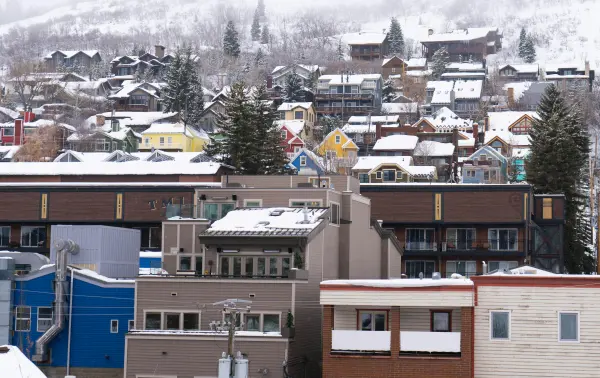
Park City rooftops under early snow — the pre-opening window when absorption reads still matter street by street. Photo: Alex Moliski / Unsplash.
Name the slice before you talk “the market”
Every useful absorption conversation starts with geography. On the Park City MLS / PCBOR map, that means: Park City Limits Areas 1–9, Snyderville Basin 10–23, Jordanelle 24–29, Heber Valley 30–47, Kamas Valley 50–53, and the board’s Primary Market (Summit + Wasatch Counties). Only areas that clear minimum transaction thresholds show up in some board tables, and the numbers are preliminary and subject to revision — which is why you label the window every time you cite it.
A Summit County sheet is not the same as Areas 1–9. A Primary Market median is not “Park City.” If you’re comparing a sitting condo at the base to a basin single-family that cut price in August, start by naming which Ar codes you’re actually in. The PCBOR quarterly hub is the place to keep that map honest.

Main Street, Park City — place context for city-limits geography (Areas 1–9), not a listing address. Photo: Saalebaer, Wikimedia Commons, CC BY-SA 3.0.

What the latest labeled windows actually show
As of mid-to-late October, the newest full PCBOR quarter on the hub was still Q2 2026 (period ending June 30) — Q3 2026 had not posted when we re-checked. That quarter logged 669 transactions and about $1.358B in volume across types — up on both units and dollars versus the prior-year quarter. Rolling twelve months to June 30 ran about $5.728B on 2,695 transactions. Those are board-labeled totals, not a November absorption rate. Open the hub again the week you decide; if 3rd Quarter is up, read that cut as the latest board window and treat the Q2 figures below as the prior slice.
Inside that same quarter, geography still split hard — and property type belonged on the label, not as the whole essay. Primary Market medians sat near $1.685M for SFH (259 sales) and $1.167M for condos (189 sales). Park City Limits SFH median around $3.8M on a thin sample, Basin nearer $2.25M, with condo tables telling their own story by Ar band. Treat every figure as “as of Q2 2026,” then refresh the PDF before you price or offer.
For winter-shoulder history, PCBOR’s Q4 2025 / calendar 2025 framing still helps: average monthly residential inventory ran about +14% year over year, with overall absorption near 5.2 months in that board narrative. Useful as labeled context — not as a substitute for a live early-November pull.
County sheets and third-party dashboards are different scoreboards
Utah Association of Realtors’ Summit County Local Market Update for August 2026 (current as of Sept. 10 on the August 2026 sheet) showed new listings 173, pendings 201, closings 193, inventory about 831, months supply near 4.6, and days on market until sale around 75. Percent of original list price received sat near 93.5% — a soft list-to-sale friction signal, not the same thing as “X% of listings took a cut.” Re-open the live Summit LMU before you lean on YoY directionality; monthly samples move.
Third-party Summit MLS commentary sometimes quotes a different months-supply band entirely. Those datasets don’t average cleanly with UAR or with PCBOR Ar tables. Pick one scoreboard for the decision in front of you, label it, and leave the others on the shelf.

Mountain-town residential streetscape — absorption is always property-type and Ar-code specific. Photo: Pexels / Pexels License.
How I’d read price flexibility before Nov. 20
Park City Mountain’s target opening is Friday, Nov. 20, conditions permitting — and prior seasons have slipped. Municipal snow ops already run Nov. 1–Apr. 30. Thanksgiving lands Thursday, Nov. 26. Together those dates bookend a short, readable window: who’s still negotiating, who’s absorbing without another cut, and which geographies look sticky.
Practically, I’d walk a sitting listing like this. Confirm the Ar codes — and note property type only as a filter label. Pull the newest PCBOR quarter you can open, plus a current MLS filter for that slice — not a blended “Park City” screenshot. Look at list-to-sale ratio and days on market for comps in that filter, not a county headline. If a price reduction exists, note the date and the prior ask; one cut after Labor Day does not equal a market-wide clearance sale. And keep private clubs out of the absorption sentence — clubs are not ski resorts, and a club-adjacent address still sells on its own Ar table.
Deer Valley’s 2026/27 opening day wasn’t posted yet — don’t rebuild your November shopping calendar around a dual-resort opening weekend that isn’t announced.
What this window is for
Early November is for literacy, not forecasts. You’re deciding whether a summer holdout in Areas 1–9 is negotiating differently than a basin listing that refreshed in September — and whether your offer or your next price move should wait for ski-weekend traffic or use the calm weeks first. The geography-and-window read is the point; the condo-vs-SFH column deep-dive belongs on its own date.
Figures above reflect PCBOR Q2 2026, PCBOR’s 2025 year-end framing, and the UAR Summit August 2026 LMU as of those releases. Pricing and inventory move weekly — we’ll pull live comps and, if useful, a dated price-reduction filter for your Ar codes before you decide.
If you want a micro-market absorption read for a specific address or shortlist before opening weekend, I’m glad to walk the labeled geography with you.
Talk with Esteban J. Nunez — Park City Realtor.
Categories
Recent Posts