From entitled lot to winter pad — what custom-build buyers decide in late October
You close on a vacant lot in late October and the next question lands fast: can this parcel still take a pad this season — excavation, limits of disturbance, foundation work — or are you buying a spring-break-ground lot and planning the calendar that way on purpose?
Mountain contractors talk about September–October as the last practical window for major exterior pours before winter weather owns the job site — that is a trade-season pattern, not a City dig ordinance. Park City’s hard-freeze normals cluster through mid-to-late October, and municipal plow season typically opens around November 1. PCBOR’s Q2 2026 land tables also showed a real surge in lot activity — buyers are acquiring land now, and pad timing is part of the purchase decision, not a footnote after closing.
This is lot-readiness and construction-season literacy across custom corridors — Basin, Summit Park, Pinebrook, Toll Creek, Jordanelle, and other Wasatch Back land geographies. It is not a Kearns Boulevard detour calendar or a municipal corridor construction wrap.

Illustrative site work — pad and dig season mood, not a named Park City project. Photo: Etienne Girardet / Unsplash.
Why late October still matters for a pad
Long-term frost tables put Park City’s median hard freeze (28°F) near October 6 and severe freezes (24°F) near October 20 — climate planning averages, not this year’s forecast and not a municipal freeze date. Local concrete and excavation trade pages frame fall as the last clean shot at major pours; winter work tilts toward emergency or interior scopes. One Park City excavation firm describes an effective digging window roughly mid-April through mid-November, with work above about 7,500 feet generally not feasible December–March because of frozen ground, snow, and road restrictions. Lower-elevation sites near Kimball Junction sometimes stretch a little further with thawing measures — site by site, not as a town rule. Treat frost and dig windows as pattern and contractor judgment, not ordinance.
Frost-line depth, mix design, and heated-enclosure winter pours belong to the stamped engineering and the contractor you hire. Marketing that mentions “about four feet” is a conversation starter, not code. Ask for the engineer’s number for this parcel.
Park City snow ops run roughly November 1–April 30. Once that window opens, staging, street snow rules, and site access get tighter. Build the pad calendar with that civic clock in view — and reconfirm live snow-ops language nearer your dig week.
What “pad-ready” looks like on paper
Before you treat a late-October close as a same-season dig, put the documents on the table:
- Which PCBOR area and which jurisdiction — Park City Municipal vs unincorporated Summit County? Permit paths differ; don’t collapse them.
- Boundary / topo survey and geotech in hand — or budgeted and scheduled?
- Utilities stubbed to the lot vs extended at buyer cost (gas, electric, sewer/water language on marketing is a prompt to verify, not a warranty).
- HOA / design-review calendar — including winter meeting gaps that can stall exterior approvals.
- WUI, Soil Ordinance boundary, building-pad limits, and setbacks on the parcel.
- Your contractor’s honest weather cutoff for this elevation, in writing.
- If the pad slips, is financing and the purchase contract comfortable with a spring start?
Illustrative open-lot marketing in the Basin and nearby corridors often highlights exactly those cues — stubbed utilities, city-approved plan language, surveys and geotech already advanced, gentle grade, marked building envelope, winter access notes. Use them as a document checklist. Live MLS status and pricing change constantly; this post does not feature any one address or asking price — pull live MLS when you are under contract on a specific parcel.

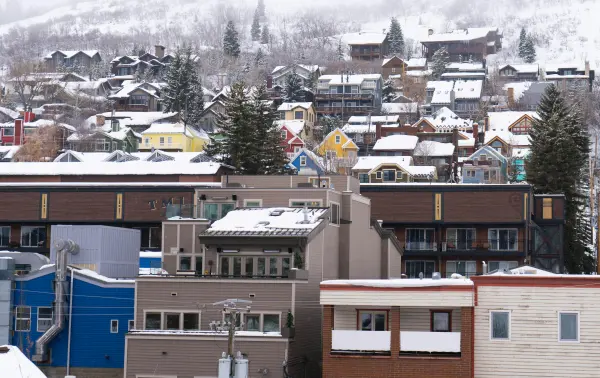
Park City winter aerial — corridor context for mountain lots, not a parcel for sale. Photo: Everwest, Wikimedia Commons, CC BY 4.0.

City permits, LOD, and before-you-dig
For parcels inside Park City, start with the Building forms and permits hub. You’ll find Design Criteria, Soil Ordinance notes, WUI materials, HOA information, Before You Dig / Blue Stakes notes, and the pointer to the USU ground snow load map. The Design Criteria 2026 PDF is the climatic and structural sheet reviewers expect applicants to respect. Nearer publish — and again the week you file — re-open that forms hub; City pages move, and a blog outline is not the live checklist.
Sequence matters. Conditional approval and deferred submittals typically lead to a scheduled Limits of Disturbance (LOD) inspection and a pre-construction meeting; construction generally begins after a passing LOD. New-construction reviews commonly include Building (structural, trades, WUI) and Planning (setbacks, height, design, pad limits). Confirm the live steps with the Building counter — 435-615-5101 / buildingcounter@parkcity.gov are on the City site — before you treat this outline as the checklist.
Before excavation, call Blue Stakes of Utah at 1-800-662-4111, obtain required building and excavation permits, and respect APWA color coding for underground utilities. Registered HOA notification for certain exterior work is a City process described on the Building HOA information page — it is not the City interpreting your design-review aesthetics for you.
What the land tables say — labeled, not as a lot pitch
PCBOR Q2 2026 (period ending June 30) was the latest full quarter on the quarterly hub when we re-checked in mid-September. Week of October 26, re-open that hub: if Q3 2026 is live, price and talk land against that labeled cut; if Q2 still leads, keep these figures and the hedge. MLS-wide land: 147 sales / $181.3M (+46% units / +74% volume). Primary Market land: 144 / $180.5M (+58% / +102%), median $1,200K.
By geography, still labeled: Park City Ar 1–9 — 2 sales / $5.7M (median $2,843K); Snyderville Basin 10–23 — 32 / $44.8M (+167% units; median $1,475K); Jordanelle 24–29 — 70 / $98.3M (+71%; median $1,366K); Heber 30–47 — 22 / $15.3M (median $487K); Kamas 50–53 — 14 / $15.3M (+75%; median $813K). Board narrative flagged activity in South Jordanelle, Promontory Area 22 land, Kamas Valley price discovery, and Glenwild land — as activity flags, not endorsements of any lot. The board also frames land as a 12–24 month leading indicator. None of those board medians are a featured MLS lot asking price.

North across Jordanelle Reservoir — geographic context for Jordanelle land corridors, not a club pitch. Photo: An Errant Knight, Wikimedia Commons, CC BY-SA 4.0.

Q4 2025 board narrative mentioned strong appetite for entitled lots with golf-club options and agent-reported premiums versus similar lots without. That is anecdotal press language, not an appraisal table — and private club membership is a club membership, not a ski-resort pass. Confirm initiation and availability with the club, not listing copy alone.
Decide pad-this-season vs spring on purpose
If utilities are stubbed, surveys and geotech are ready, design review has a winter path, and your contractor still has a dig window at this elevation, a late-October close can still aim at a winter pad — with weather risk priced into the schedule. If any of those pieces are missing, buying the lot as a spring start is often the cleaner decision: you own the dirt, and you stop pretending November concrete is free.
Don’t use a blog average for pad cost, HOA dues guesses, and lot price anecdotes from yesterday’s MLS. Jurisdiction, documents, and the contractor’s weather cutoff decide more than a blog average ever will. This is not engineering or legal advice.
If you’re under contract on a custom lot — or comparing two parcels — and you want help mapping lot docs, HOA design-review timing, and whether a pad this season is realistic at that elevation, I’m glad to walk the build-season fit with you.
Talk with Esteban J. Nunez — Park City Realtor.
Categories
Recent Posts